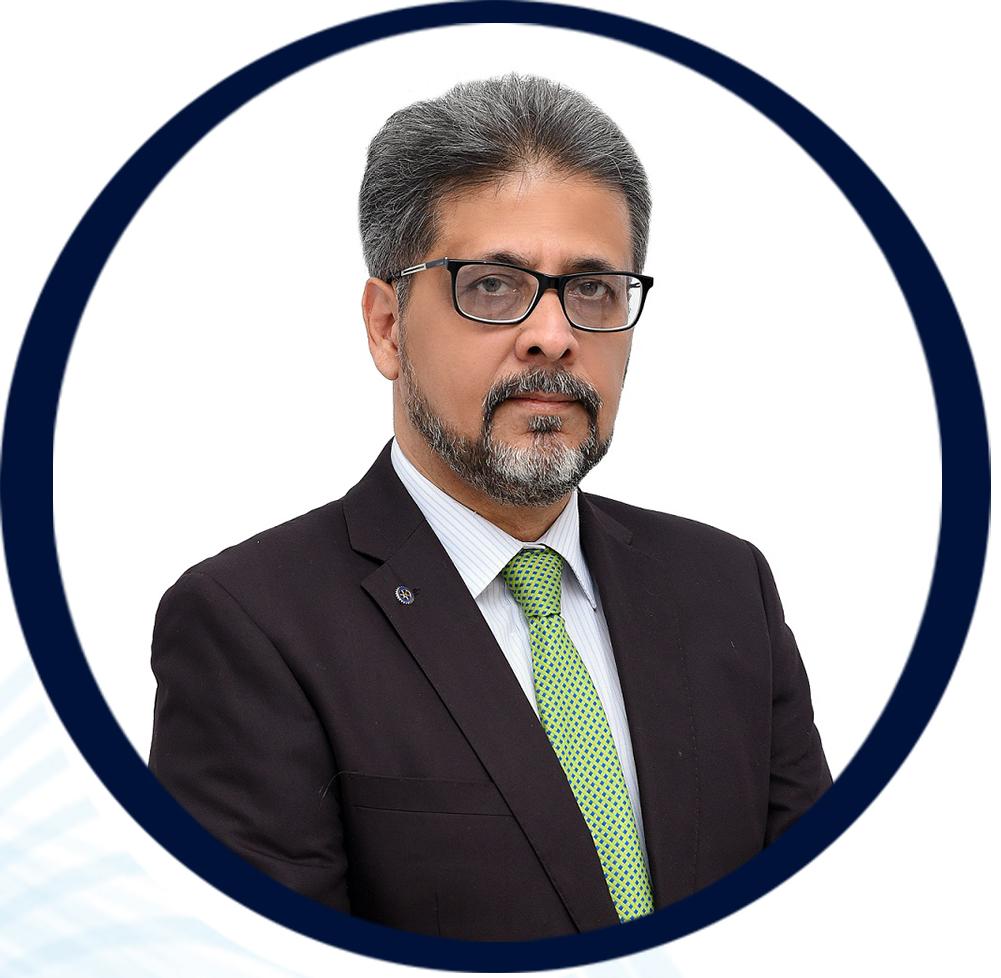
Director, ORIC — Salim Habib University | Founder & CEO, Cambridge Advisors Network
For over three decades, Azhar Rizvi has built the scaffolding of Pakistan's entrepreneurship and innovation ecosystem — training founders, building university incubation centers, and connecting Pakistani talent to global opportunity, all in service of a more self-reliant Pakistan.
Azhar Rizvi began his career automating banking and telecom infrastructure for NCR/AT&T, UNISYS, Hughes Network and his own venture, THK Solutions — work that connected 800+ cities and trained thousands of banking professionals across Pakistan. In 2007 he founded Cambridge Advisors Network (CAN) to channel that experience into building Pakistan's entrepreneurship ecosystem: from bringing the MIT Enterprise Forum to Pakistan, to designing the ORIC and Business Incubation Center framework now used by 50 universities nationwide.
Alongside his entrepreneurship work, he has spent three decades in social impact — from telemedicine networks that reached earthquake-affected regions, to an online learning platform for women, to reforming records at a women's central prison that freed 1,350 wrongly-detained inmates.
On the auspicious occasion of Pakistan's Independence Day, the President of Pakistan announced the conferment of the Tamgha-e-Imtiaz upon Syed Azhar Rizvi, Director ORIC at Salim Habib University, in recognition of his outstanding contributions to research, innovation, entrepreneurship development, and the commercialization of ideas for national progress and sustainable impact.
The Habib Public School Alumni Association (HPSAA), where he serves as Vice President, and the entire Habibian community joined in celebrating this honour — recognizing his meritorious services in the field of education.
A selection of measurable outcomes across his entrepreneurship, education and social-impact programs.
From bringing MIT's methodology to Pakistan to designing national incubation policy — the programs behind the numbers.
Brought the MIT Enterprise Forum to Pakistan and established the MIT Business Acceleration Program (BAP) — a four-phase, six-month program taking IT founders from writing a business plan through mentoring by local and international entrepreneurs, judging by a panel of renowned Pakistani-American entrepreneurs from Silicon Valley firms, pitching to MIT's Entrepreneurship Center faculty, and a roadshow through Boston, New York, Washington DC and San Francisco to meet the Pakistani diaspora and global IT community.
Founded CAN in 2007 to institutionalize entrepreneurship ecosystem-building in Pakistan. Flagship engagement: partnering with the Higher Education Commission (HEC) since 2007 to develop the national policy for Offices of Research, Innovation & Commercialization (ORIC) and Business Incubation Centers, then training Directors, Managers, Deans and PhDs across 50 universities nationwide.
Developed and led INVENT at the request of then-Director Dr. Ishrat Hussain, modeled on the MIT program. Grew from 15 to 65 participating universities, with over 10,000 students and 500+ projects competing each year.
Instituted at the request of Lt. Gen. Muhammad Asghar (then Rector, NUST) and Rear Admiral Muhammad Mushtaq (Provost). A five-month intensive of training, mentoring and industry coaching, carrying the direct patronage of the Prime Minister's office as the "PM's Entrepreneurial Challenge."
Following the impact of IBA-Invent and NUST-Discover, Pakistani students at leading US universities asked for a similar platform abroad. Azhar Rizvi conceived Pakathon together with Zheela Qaiser and Asad Badaruddin (graduates of Yale and Tufts). Over three years, 55 universities across the US, Canada, Australia and the UAE joined the movement.
Under CAN, led a four-phase national program with the Ministry of IT's ICT R&D Fund to commercialize academic research.
Engaged by the Sindh Board of Investment and Sindh Enterprise Development Fund to develop an agri-entrepreneurship program — five months of training, mentoring and coaching.
The technology and telecom career that laid the foundation for three decades of ecosystem work.
Multi-National Accounts Manager. Automated PTCL with a state-of-the-art billing system, and delivered automation projects for Habib Bank in New York, Fiji and Nigeria.
Led banking systems automation for UBL, ABL, and Habib Credit & Exchange Bank.
Worked with Hughes Network's Pakistan representative to build satellite and internet connectivity for the banking, defense, and oil & gas sectors.
Established EBiz Solutions in Pakistan, growing it from 2 to 52 employees with a sizeable revenue base.
Automated HBL's first-ever nationwide branch automation and VPN connectivity, training 10,000 bank professionals across a network spanning 800 cities. Also automated UBL and Emirates Bank International. A 2006 NASSCOM trip to India led to two projects with the National Association for the Blind: upgrading PASHA to a paid secretariat and implementing DAISY digital reading systems in five Pakistani schools for the vision-impaired.
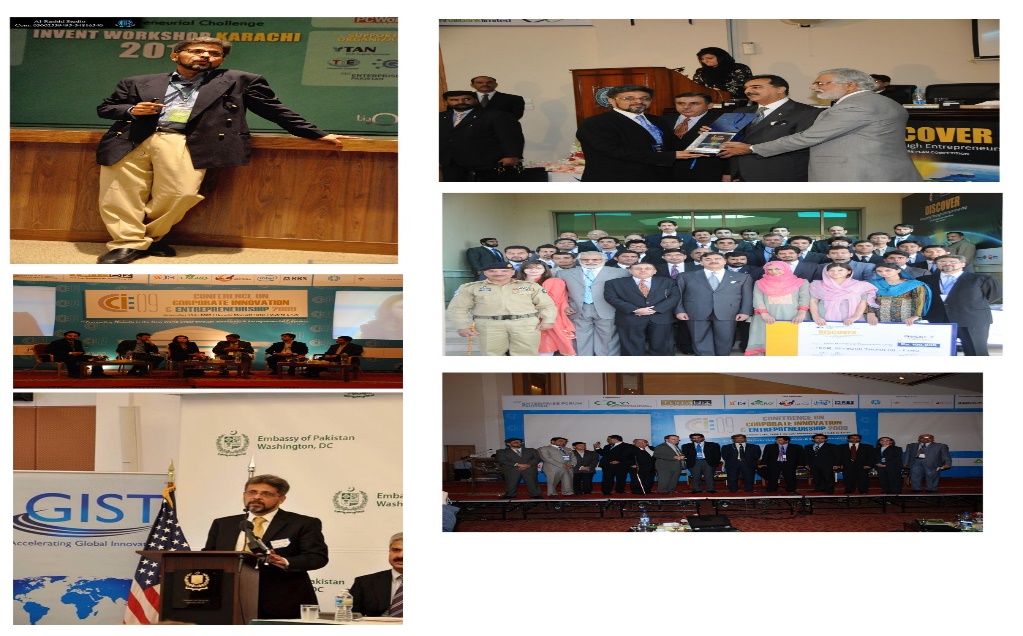
From national forums to global roadshows — three decades of building ecosystems, one program at a time.
For speaking engagements, mentorship, ORIC/incubation advisory, or program partnerships.
Service With Compassion
Three decades of civic and humanitarian work, run alongside his entrepreneurship career.
Rotary International
Launched a vocational training program for 9th & 10th grade students at Jacob Lines Government High School with the Kutiyana Memon Association, sponsored by NCR Pakistan — 150 boys trained per batch, every year, for 8 years.
Automation of Women's Central Prison
Built an inmate database for a prison holding 1,500 women in space designed for 150, uncovering incomplete records. The system led to 1,350 women being freed, and was later replicated in several cities.
Online LMS for Women
Founded a non-profit online education platform offering degree and certificate courses to women worldwide — 10,000 women enrolled within the first year. Enhanced in 2008 with DAISY-enabled digital learning and Pakistan's first digital Quran.
Earthquake Telemedicine Network
Applying lessons from banking automation, developed a nationwide telemedicine concept with Rawalpindi Medical College and Holy Family Hospital. Established 14 centers across KPK and Azad Kashmir with the Pakistan Army Medical Corps, Intel Pakistan, ITU, PASHA, PSEB and the PM Secretariat — saving hundreds of thousands of lives.
Attock Telemedicine Centers
Extended the telemedicine model to Attock district with USAID, connecting DHU/RHU/BHU facilities to Rawalpindi Medical College and Holy Family Hospital — 50,000 patients seen by hospital doctors every month. Findings were presented at the 1st International ITU Conference in Islamabad across 8 papers.
Rashidabad Memorial Welfare Organisation
Serves as advisor to RMWO, focused on fundraising and technology infrastructure for Rashidabad village in interior Sindh — a sustainable-society model spanning education, health, environment and socio-economic development for the underprivileged.
Civil Hospital Automation
Led a THK CSR project to transform Civil Hospital into an open-source, HIPAA-compliant automated system through to full operational handover — later used as the model to automate four further government hospitals.